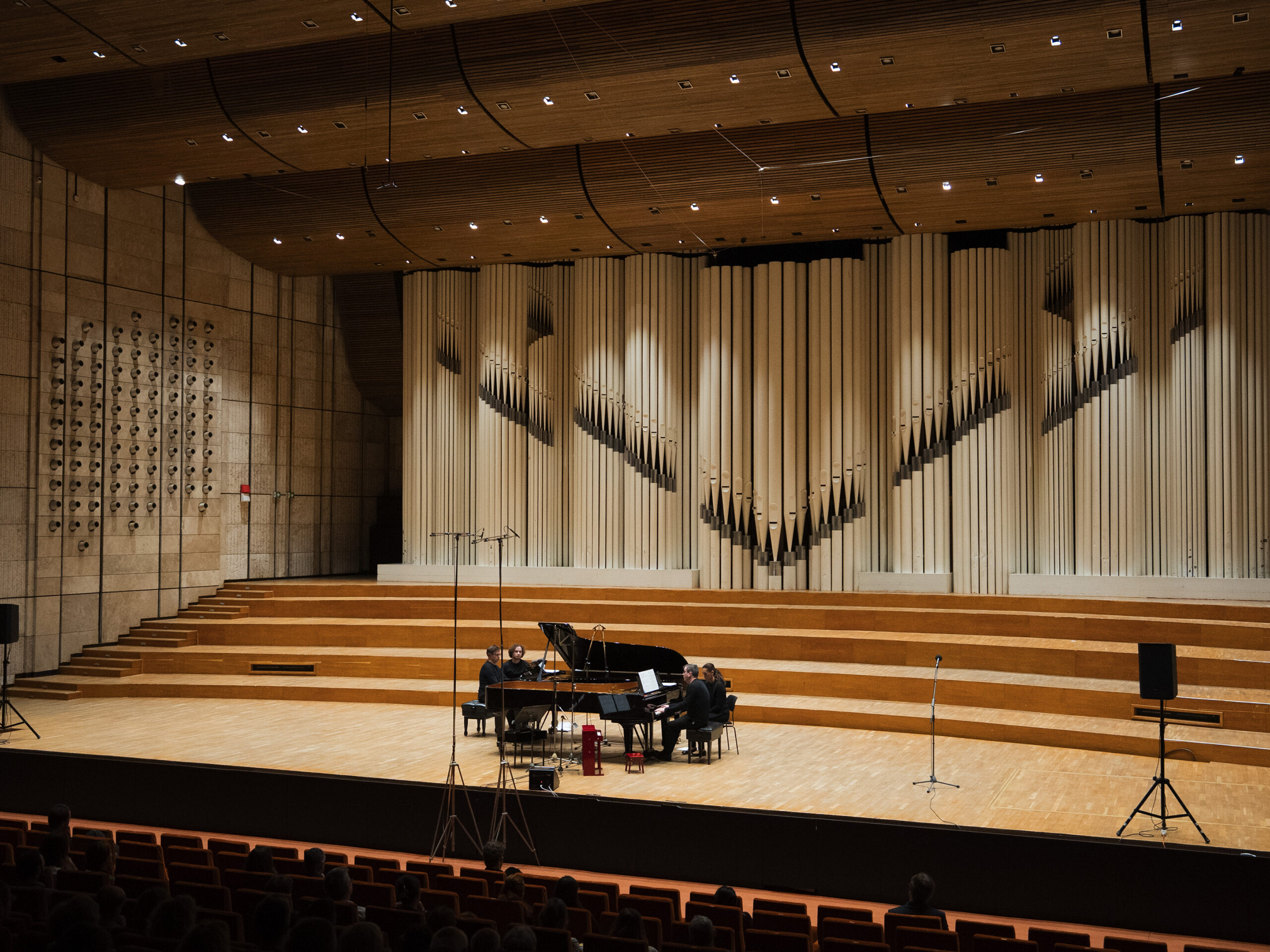
13th December 2025 – BRATISLAVA, Concert Studio of Slovak Radio Building
The recital programme Dialogue, with pianist Ivan Šiller as the soloist, set out to connect the old with the new (Schubert with Bartók, Bartók with Kurtág, tradition with experiment) and, in the words of the PR texts, to bring a quiet as well as passionate conversation across the centuries. Such formulations are appealing, but also risky. The word dialogue assumes that both conversing sides truly hear one another, respond to each other, and that a tension arises between them that is not merely the contrast of “old versus new” but also an exchange of meanings. During Šiller’s recital it ultimately became clear that, more convincingly than a dialogue of eras, what worked was a dialogue of composers—especially where the dramaturgy was assembled as a chain of short gestures that complemented one another. The audience was prepared for an interpretive walk among icons of twentieth-century Hungarian music (Bartók – Kurtág – Eötvös), with an international extension (Berio) and a domestic entry (Jánošík). The counterpole was to be Schubert’s Sonata, as a more traditional conception of sound and aesthetics. Already here I ask: is a counterpole automatically a dialogue? Or merely a sharp cut?
Béla Bartók’s opening Six Dances in Bulgarian Rhythm immediately drew the audience in; after just a few bars it was clear that the evening would rest on rhythm, energy, precise articulation, and dynamic turns. In Šiller’s interpretation the dances were lucid, with a clear pulse and distinct small accents, balanced voices, and exact dynamic contrasts. This music is ideal for hearing the piano not only as a singing instrument but also as a rhythmic organism—Bartók’s tendency to move from the “beautiful tone” toward an instrument with percussive potential. Here the pianist did not come across as an interpreter who needed to force the piece into relief; rather, he let it do its work (to lighten, to tune in, to play).
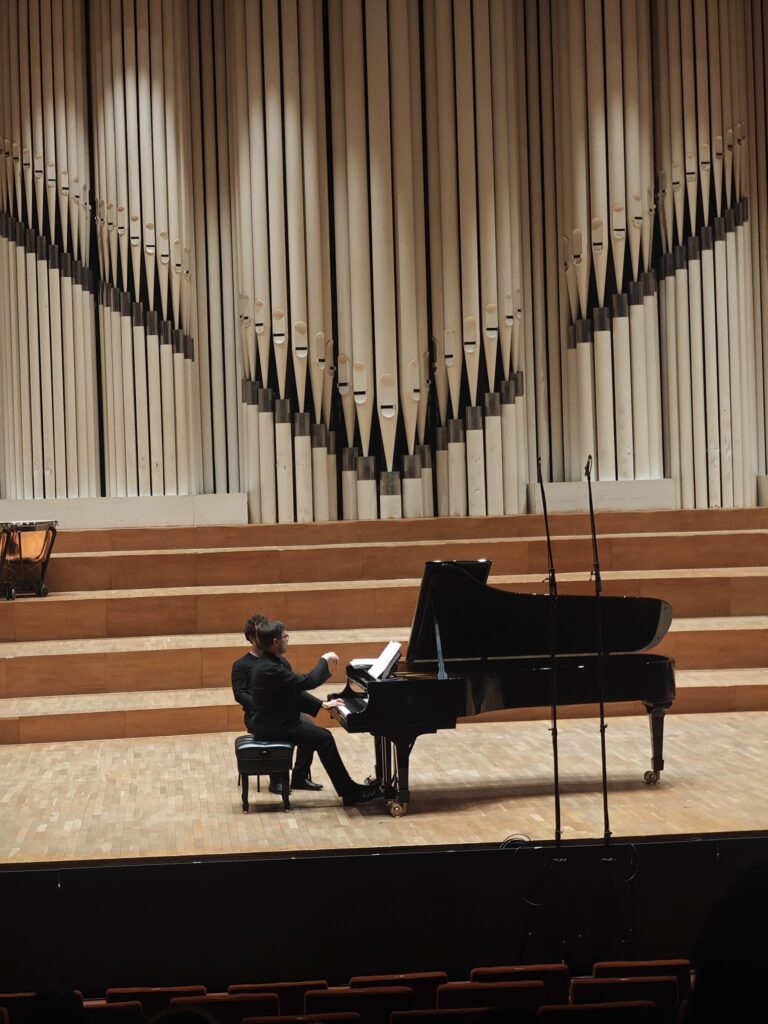
Then came Schubert—an interpretive peak, yet a dramaturgical question mark. Šiller’s performance of Franz Schubert’s Sonata No. 14 in A minor, D 784, sounded with tremendous interpretive breadth. The contrasts were convincing and the dynamic arcs logically built. At one moment it truly seemed that the dialogue was taking place within the piece itself, as if Schubert were conducting a conversation with himself in this music—between resignation and defiance, between intimacy and sudden constriction. Yet it was precisely here that the problem of the basic PR frame “old versus new” became apparent. If Schubert was to be a bridge or a counterpole, it needed to be dramaturgically anchored so that listeners could smoothly change their mode of listening. In this programme, however, the Bartókian folkloric pulse gave way directly to Schubertian gravity without sufficient bridging. Šiller did justify the choice of the work by the Advent season (and thus by the choice of serious, intimate music), but for that very reason the contrast felt not like a dialogue, but like a sudden transfer into another world—after which the mood in the hall, despite the excellent performance, seemed to drop.
Interestingly, a similar “Schubertian exclamation mark” also appears in reflections on Šiller’s other programmes: Hudobný život, in connection with his May recital in the Reduta, also speaks of Schubert as an unconventional, gently surprising element within an otherwise unified dramaturgy. During Saturday’s concert, however, Schubert was not only a surprise but also the most extensive work, which for a moment overloaded the basic line of the Hungarian school and its echoes.
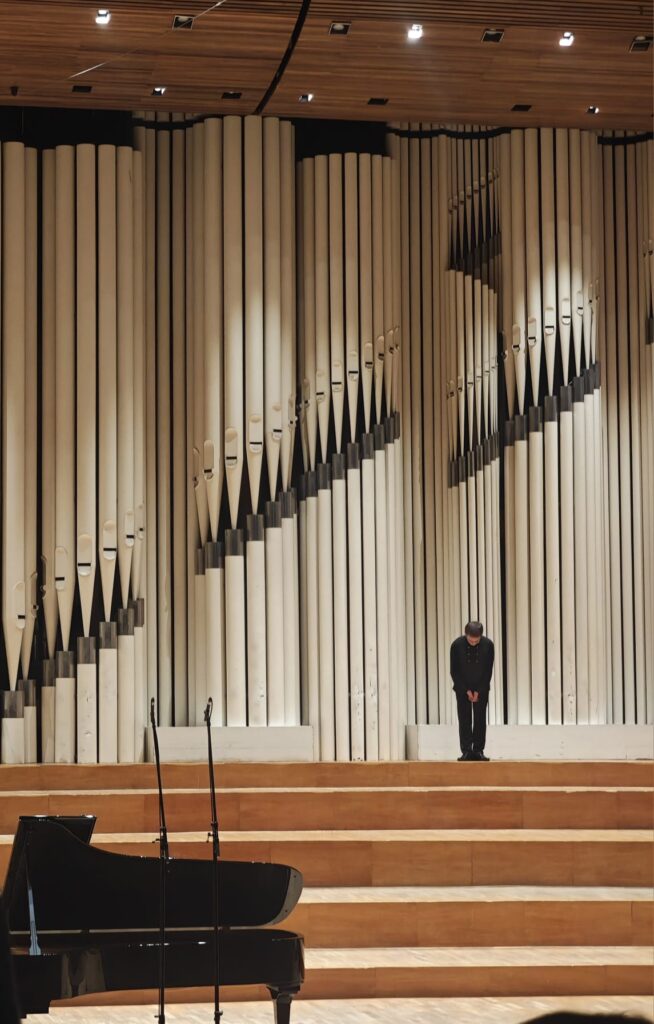
The most convincing part of the evening came when the programme flowed into a chain of short pieces (Martin Jánošík – György Kurtág – Luciano Berio – Péter Eötvös), performed without longer pauses and without applause between them. Here the point of the whole concert (a true dialogue) was fulfilled: the pieces followed one another as if they were communicating—not declaratively, but sonically. The pianist also contributed by stating, before this section, his intention to “let the listener get lost,” to make the block ordering into a kind of suite in which the authors respond to one another. Martin Jánošík’s miniatures (Sostenuto, rubato ma non troppo; Orange Rain; For Ivan; Happy Birthday, György Kurtág) felt like a sensitive opening of space. The slower pieces were precise, almost intimate; the faster ones had spark and brightness. The subsequent tributes by György Kurtág (Hommage à Schubert, Farkas Ferenc and Péter Eötvös) masterfully combined emotion with the work’s meaning. The composer’s intention—that every note and every pause has its justified significance—was clearly conveyed by the pianist. Into this line entered Luciano Berio with Earthly Piano, followed by Péter Eötvös with his Earthly Piano – Heavenly Piano (written in memoriam Luciano Berio), a dramaturgically exact gesture in which the dialogue is almost literal. The same title, yet a completely different way of listening: with Berio, the piano seems to remain firmly earthly, anchored in touch and the materiality of sound, while Eötvös adds another dimension to the same idea—more space, more work with resonance. It was precisely here that Šiller’s wish for the listener to get lost for a moment could be fulfilled most easily.
After the sound-suite, Béla Bartók’s Divided Melody felt like a pleasant return to the folkloric source—as if the listeners, after experimenting with colour and silence, were materialising on the ground again. After it came György Kurtág’s Double Notes as a coda to Bartók’s melody, quoting the pianist from the beginning of the concert. The finale belonged to Béla Bartók’s Romanian Dance No. 1, which sounded in the hall like an energetic wave. The dance came across with full sound, energy, and certainty; after all the contemplation and the sonic laboratory we can speak of an energetic climax, and the standing ovation felt like a natural closing of an arc that began with dance-like character and ended with it as well.
Hana CHLEBÁKOVÁ