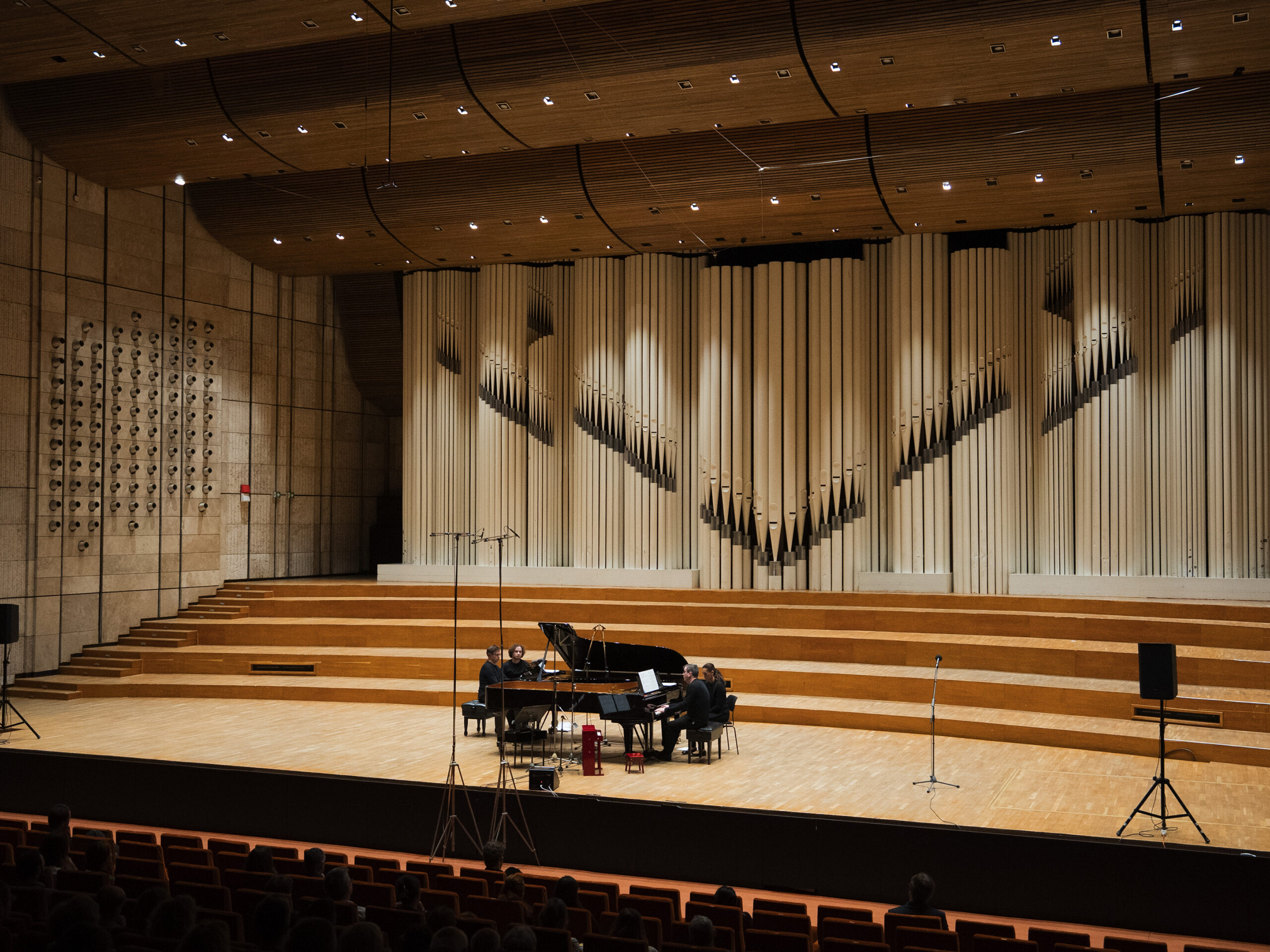
13 December 2025 – Bratislava, Large Concert Studio of Slovak Radio
In the Western tradition, Advent marks the beginning of the new liturgical year. It brings with it an invitation to stillness and reflection, while at the same time carrying an excited anticipation of Christmas. All of these aspects of the season of expectation were undoubtedly taken into account by the artistic director of Ensemble ricercata and outstanding pianist Ivan Šiller when shaping the dramaturgy of this pre-Christmas concert aptly titled Dialogue.
The programme was divided into four diverse blocks. The first was filled by Béla Bartók’s Six Dances in Bulgarian Rhythm. Fascination with folklore is and has never been a rarity in our geographical context, yet no other composer in the sphere of classical music worked with it with such enthusiasm as Bartók. His distinctive folk-inspired melodic language and driving rhythmic vitality, clothed in a sophisticated harmonic framework, always sound strikingly modern. In these particular dances, the use of almost jazz-like dissonances even fleetingly recalled the music of Nikolai Kapustin, who was undoubtedly inspired by Bartók. Šiller’s interpretation clearly demonstrated his intimate familiarity with the material and, above all, his affection for it. He therefore quite rightly focused on precision and clarity. In Bartók’s dance-driven works, the piano becomes as much a percussive instrument as a melodic and harmonic one—an aspect Šiller captured perfectly.
A radical stylistic contrast to Bartók’s elemental energy followed in the form of Franz Schubert’s Piano Sonata No. 14 in A minor, which constituted the second block of the programme. Even before the concert began, Šiller remarked on how well Schubert’s sonatas suit the Advent season, and the audience could only agree. Historically, these sonatas stand somewhat in the shadow of those by his contemporary Beethoven, and it is true that in terms of structural construction Schubert often comes off second best. Yet in terms of originality and expressive richness, the two are at the very least equal rivals. Schubert’s music possesses a timeless quality, full of unexpected turns and contrasts, alternating with methodical calm and melancholy. As with Bartók, clarity and controlled precision are essential in interpreting Schubert—qualities that rank among Šiller’s greatest strengths. He does not shine through bravura passages or exposed virtuosity, but rather through refined subtlety and exactitude.

The third block opened with works by a representative of the younger generation of Slovak composers, Martin Jánošík. Four short pieces were performed, which felt particularly refreshing after the extended sonata movements. The more traditionally inclined Sostenuto rubato ma non troppo, enriched with modern expressive means, served as a bridge to the programmatic miniature Orange Rain and the two dedicatory compositions For Ivan and Happy Birthday, György Kurtág. This selection revealed the composer’s stylistic flexibility and compositional dexterity. It also initiated a sequence of works paying tribute to, and expressing reverence for, compositional and interpretative icons and sources of inspiration.
This tendency was continued by works of György Kurtág: Hommage à Schubert, Hommage à Farkas Ferenc and Hommage à Péter Eötvös. The first of these dedications has an ominous character, and only experienced listeners are likely to discern its connection to Schubert through its dense dissonances. Similarly, in the following two pieces, Kurtág’s modern idiom predominates, offering his personal, initiated reflections on two fellow composers. The most radical figure on the programme was Luciano Berio. His miniature Erdenklavier, however, sounds surprisingly aesthetic by his standards, above all due to its exquisite sound quality, which Šiller conveyed superbly. The pianist then continued with another tribute to Berio—Erdenklavier–Himmelklavier in memoriam Luciano Berio (Version I) by Péter Eötvös—followed by the most colourful piece of the evening and a beautiful sonic image, The Dances of the Brush-Footed Butterfly.
The final, fourth block returned to Kurtág and Bartók. Bartók’s divided melody and Kurtág’s two-note sonorities appeared as two radically different yet related sides of the same coin. Romanian Dance No. 1 closed the dramaturgical bridge established at the beginning of the evening and created a perfect dramatic finale. While ecstatic, turbulent expression suits Šiller perhaps slightly less than controlled sophistication, it nevertheless provided a stylistically brilliant conclusion to an exceptionally successful evening of pianistic colour. The standing ovation at the end was fully deserved.
Jakub GOČ