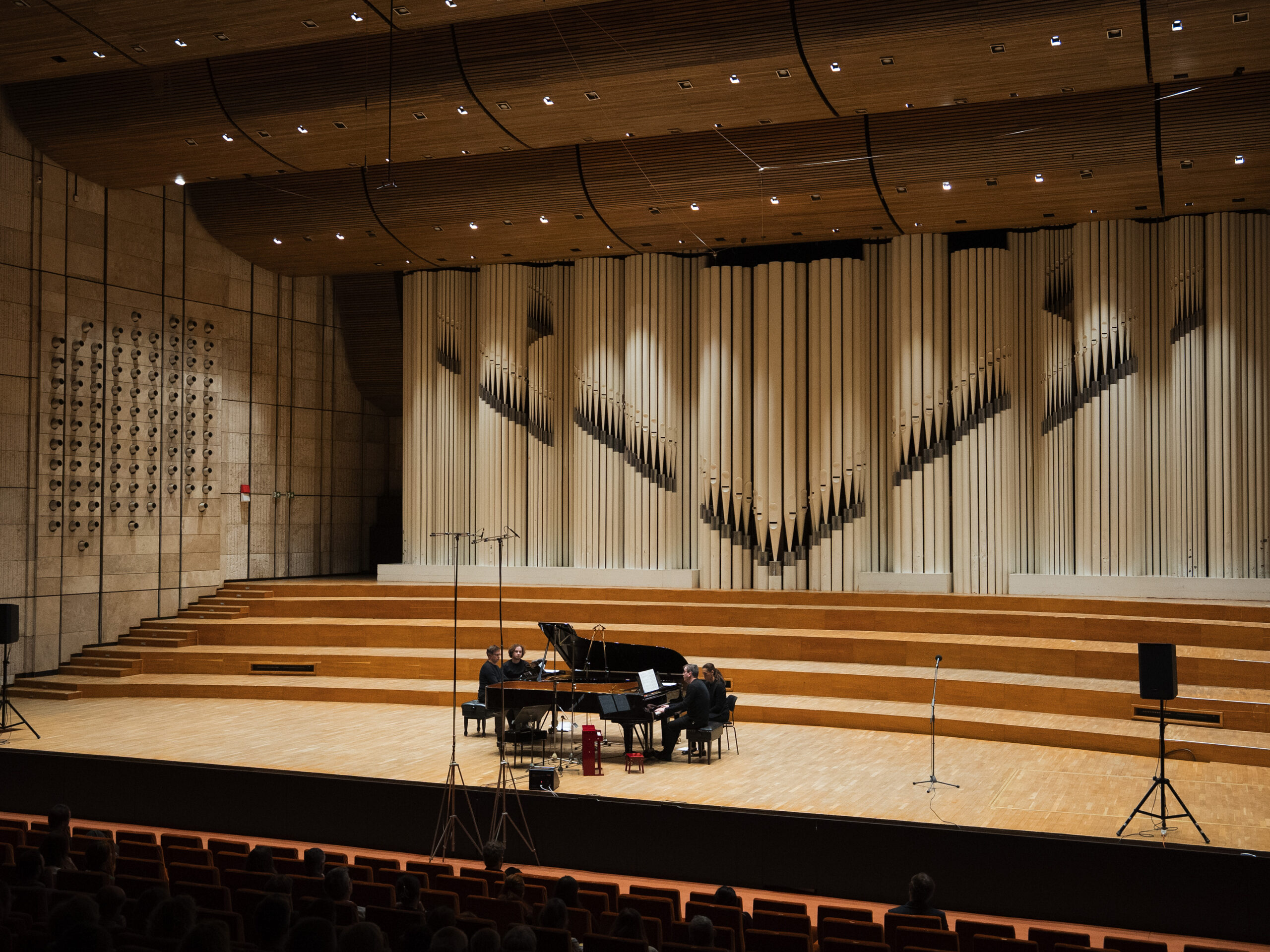
29th October 2026 – BRATISLAVA, Pistori palace
VENI ensemble has been active on the Slovak scene since 1987, and over nearly four decades it has become, as the ensemble itself puts it, an open artistic platform rather than a concert ensemble in the traditional sense. At Pistori palace it appeared in a chamber line-up consisting of Ronald Šebesta on clarinet and bass clarinet, Michal Matejka on electric guitar, Milan Osadský on accordion, and the ensemble’s artistic director Daniel Matej on laptop and Elektrosluch. The Bratislava evening brought to a close a short tour with previous stops in Košice and Poprad, which the ensemble combined with workshops for secondary school and university students. The chance to encounter contemporary music directly from those who create and perform it is of incomparably greater value to a young listener than any second-hand account.
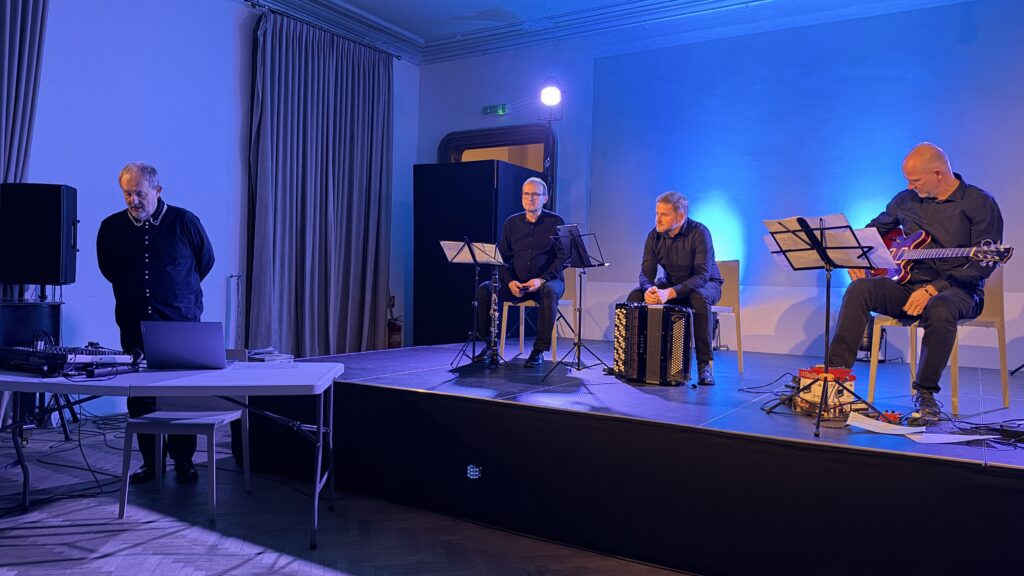
The programme was not conceived as a sequence of separate numbers. The individual compositions flowed into one another and the listener was invited to take in the evening as a single uninterrupted musical stream. The connective tissue came from the short electronic interludes of Matej’s cycle CAVE SONGS [re-mixed], which recurred throughout the programme and between which the individual players were given room for solo appearances. Each of them had a sonic physiognomy of its own, while their programmatic titles helped orient the listener as to what to look for within the collage, making the listening experience considerably more accessible.
Matej’s E [for e. g.] for electric guitar is framed by elemental chordal playing that follows the notated part precisely while continuously shifting in its rhythmic pulsation. Between the two outer sections the performer is given space for improvisation, imitating a guitar solo and playing with an echo effect. Michal Matejka handled both modes with equal assurance. Let Me Die Before I Wake by Salvatore Sciarrino unfolds almost entirely at low dynamic levels and with a minimum of material. The composer nevertheless calls on a range of playing techniques, which the clarinettist Ronald Šebesta handled with genuine brilliance. The Edge of Self by Nirmali Fenn, in turn, tested the sonic potential of the accordion, placing its centre of gravity on the work of the bellows. Milan Osadský gave the piece a plasticity thanks to which it sounded not like a technical study but like a fully-fledged work with an expression of its own. Trio for three optional instruments by Pedro Rebelo went furthest in its openness, the only work of the evening notated as a graphic score. The final shape of such a piece depends on the communication between the performers and on their listening to one another. Short motivic figures passed from instrument to instrument without a single falter, each of them retaining a character of its own. The close belonged to Daniel Matej’s CODA [to Ho-chi-min] no. 3, in which the acoustic instruments gradually joined the electronic track. The transition was so skilfully and naturally made that a listener who happened not to be watching the performers might not have noticed the instruments entering at all. This merging was a precise completion of what the programme had been suggesting from the very first bars.

The programme corresponded to the first of the two CDs of a similar name, CAVE SONGS, which the ensemble released in 2023. The audience that came thus knew what kind of music to expect. On a tour combined with workshops for young listeners, it might have been worth bringing something not yet recorded. What matters most, however, deserves recognition. It is precisely ensembles of this kind that show audiences where music is heading, give living composers a stage, and patiently cultivate listeners along the way. Without them, contemporary music would reach the public only with difficulty, and any sense of where music has been heading since 2000 would remain a matter of recordings and specialist texts rather than of live listening.
Hana CHLEBÁKOVÁ