16 September 2026 – BRATISLAVA, Moyzes Hall
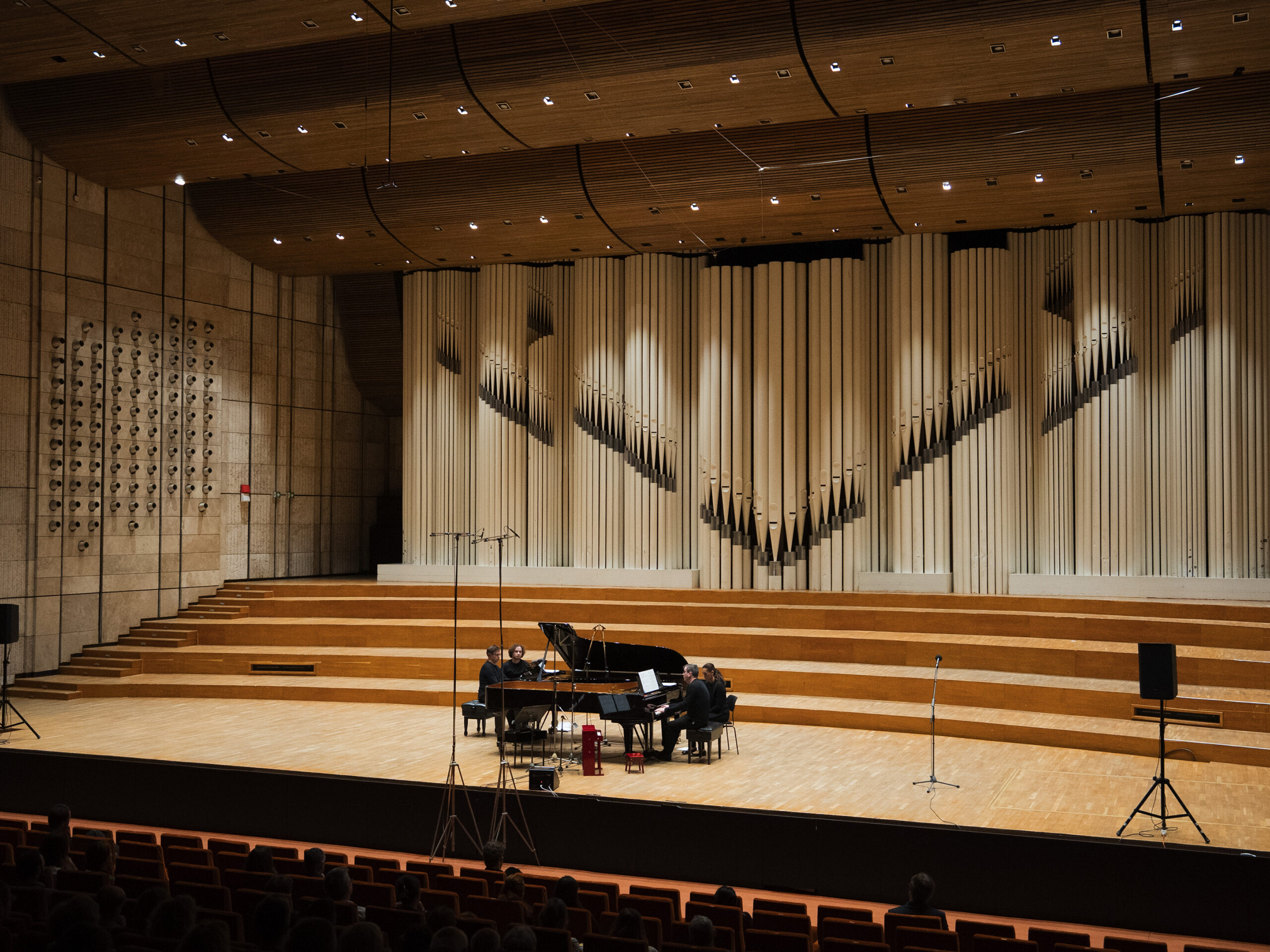
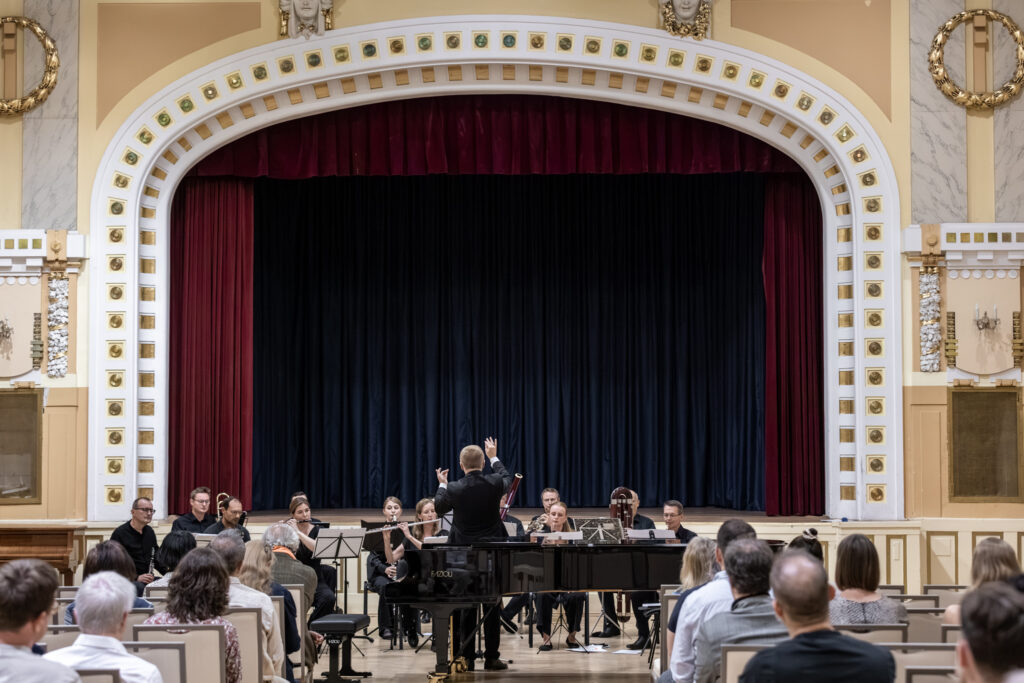
One hundred and one years ago, Alban Berg completed his Concerto for Piano, Violin and 13 Wind Instruments. This instrumentation provided the starting point for Thirteen Winds, the final concert of the second season of the CODEnsemble project. Five world premieres by Slovak composers were united by the theme of transformation, in keeping with the project’s dramaturgy. Alongside this central theme, another common thread emerged – various forms of return. Four of the five composers returned to their own past: to an earlier composition, their student years, childhood, or material that had remained unused in a drawer for many years. The question remains why such a carefully conceived project failed to fill Moyzes Hall. The half-empty hall at a concert featuring world premieres of Slovak music was a sad fact.
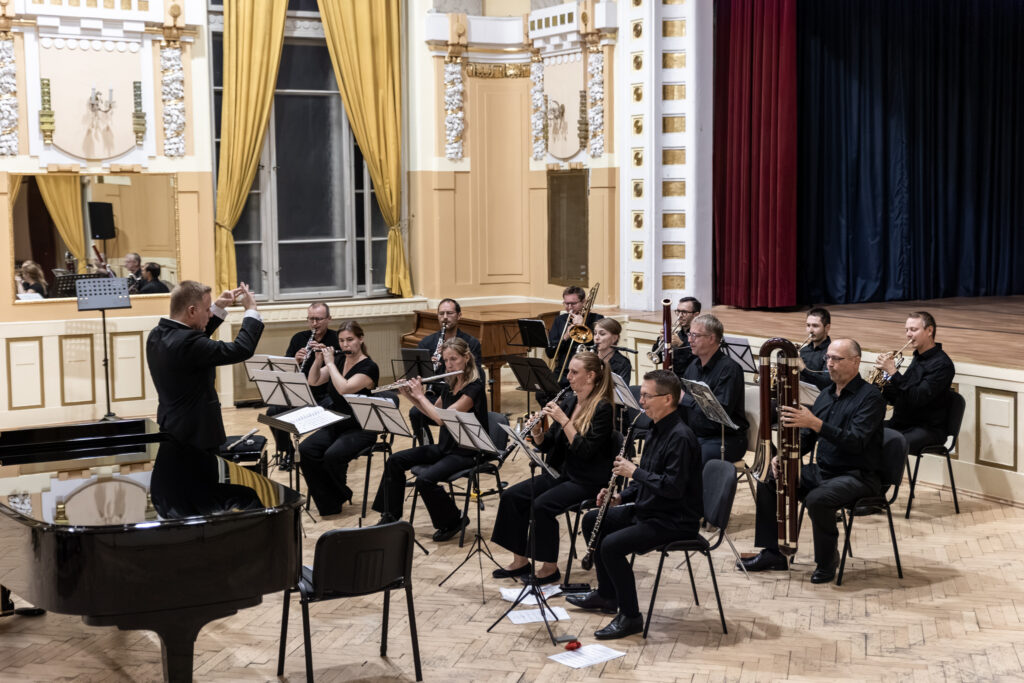
The evening opened with TAAS for 13 wind instruments by Marián Lejava, the composer and conductor of the concert. He describes it as his “musical look into the mirror”, drawing its material from his earlier cycle Another Seven Bagatelles. The titles of the four sections, played without interruption (Thesis, Apodixis, Antithesis, Synthesis), form an acronym for the title of the piece. What interested M. Lejava in the aforementioned Bergian instrumentation was the presence of thirteen independent instruments that coexist, pass material between one another and create a dynamic sound structure. This intention gradually revealed itself throughout the piece, which unfolded in dramatic waves and built not only dynamically but also through the gradual involvement of additional instruments. At first, the soft sonority of the bassoons stood out, followed later by an unusual blend of instrumental colours. Euphonic intervals alternating with rhythmic breath effects gave the whole piece a distinctive character. Fortissimo unisons combined with tapping on the instruments occasionally lent the music an almost fateful quality.
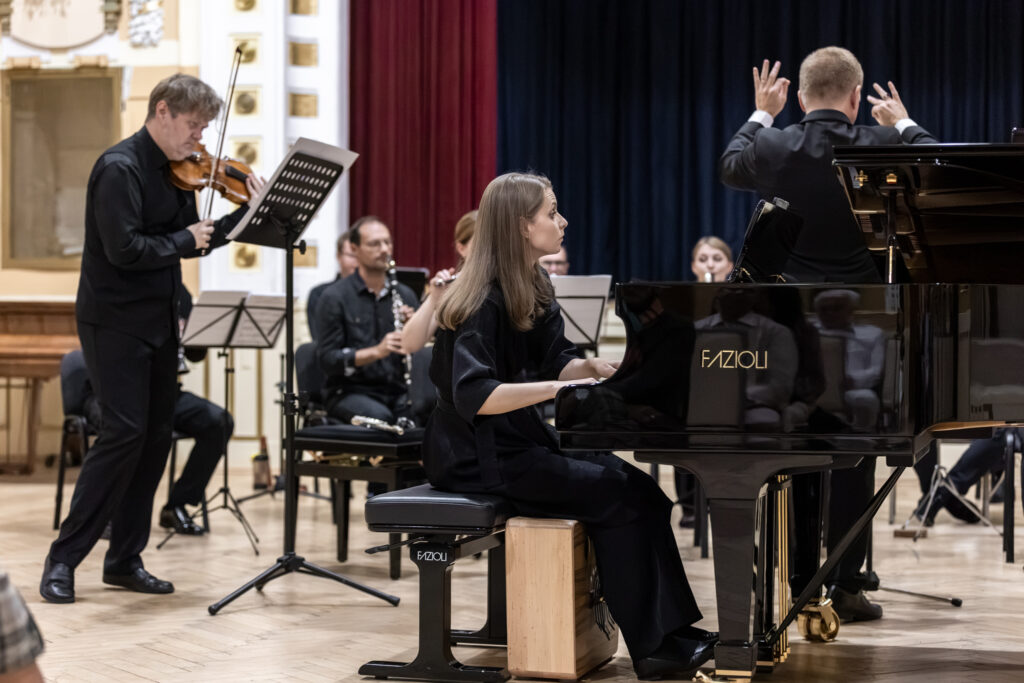
Fancy Toys for solo violin, solo piano and 13 wind instruments by Jana Kmiťová transported the audience into a completely different world – playful, spontaneous and at times uninhibited. Here too, the starting point was a return, this time to childhood play, which the composer rediscovered with her daughters. Fragments were passed between the instruments in dialogue. While M. Lejava allowed individual sound layers to gradually emerge and transform, J. Kmiťová had them sound simultaneously and merge with one another. The humour was underscored by a brief vocal passage reminiscent of children’s cries. On the violin, Milan Paľa seemed like an eternally playful child, answered in equally playful fashion by the flutes, while Katarína Paľová anchored the action with ostinato bass tones. The climax came in a gradually intensifying minimalist passage.
The short TILT for 13 wind instruments by Peter Dan Ferenčík served as an intermezzo. It grew out of an earlier composition and memories of his student years. The music played with a fragment both harmonically and melodically, while small surprises sustained the tension of what might come next. The piece’s brevity did not work against it, although a larger space might have allowed listeners to find their way more easily through its material.
Rather than looking back, Anton Steinecker turned inward in Schatten for 13 wind instruments. The composer speaks of light passing through shadow and of how a shadow changes depending on the angle from which we look at it. This was reflected in the work’s soundscape, where distance met proximity. The piece was darker and more sombre than those that preceded it. Sounds intertwined across a broad range, while the silence between individual waves felt welcome. Some passages, however, came across as heavy-handed. The constant transformation of the sound material at times failed to provide the listener with a sufficiently firm point of reference. Harmonious and euphonic resolutions would briefly restore it.
The darkest pole of the evening was SUUM by Milan Paľa for solo piano and 13 wind instruments. This premiere, too, was a return – to material that had remained unused for a long time. A line from the poem accompanying the piece, referring to the “whisperer of the exposed nerve”, foreshadowed its personal, intimate and painful character. The rich, turbulent sound and dramatic exchanges between the instruments, at times resembling arguments more than dialogues, achieved great force. K. Paľová took on the solo part and demonstrated precise control of resonance and decay. The fading of the sound itself was among the work’s most powerful moments.
The greatest response from the audience went to the works by J. Kmiťová and M. Paľa, the two pieces that relied on the most sharply defined forms of expression. Five premieres in a single evening are a commendable achievement, but still more of an exceptional event than an established practice. For such evenings to become a standard rather than a rarity for the initiated, the determination of the ensemble and the applause of a handful of loyal listeners are not enough. What is needed is sustained support for projects that do not relegate contemporary Slovak music merely to the margins of the season.
Hana CHLEBÁKOVÁ