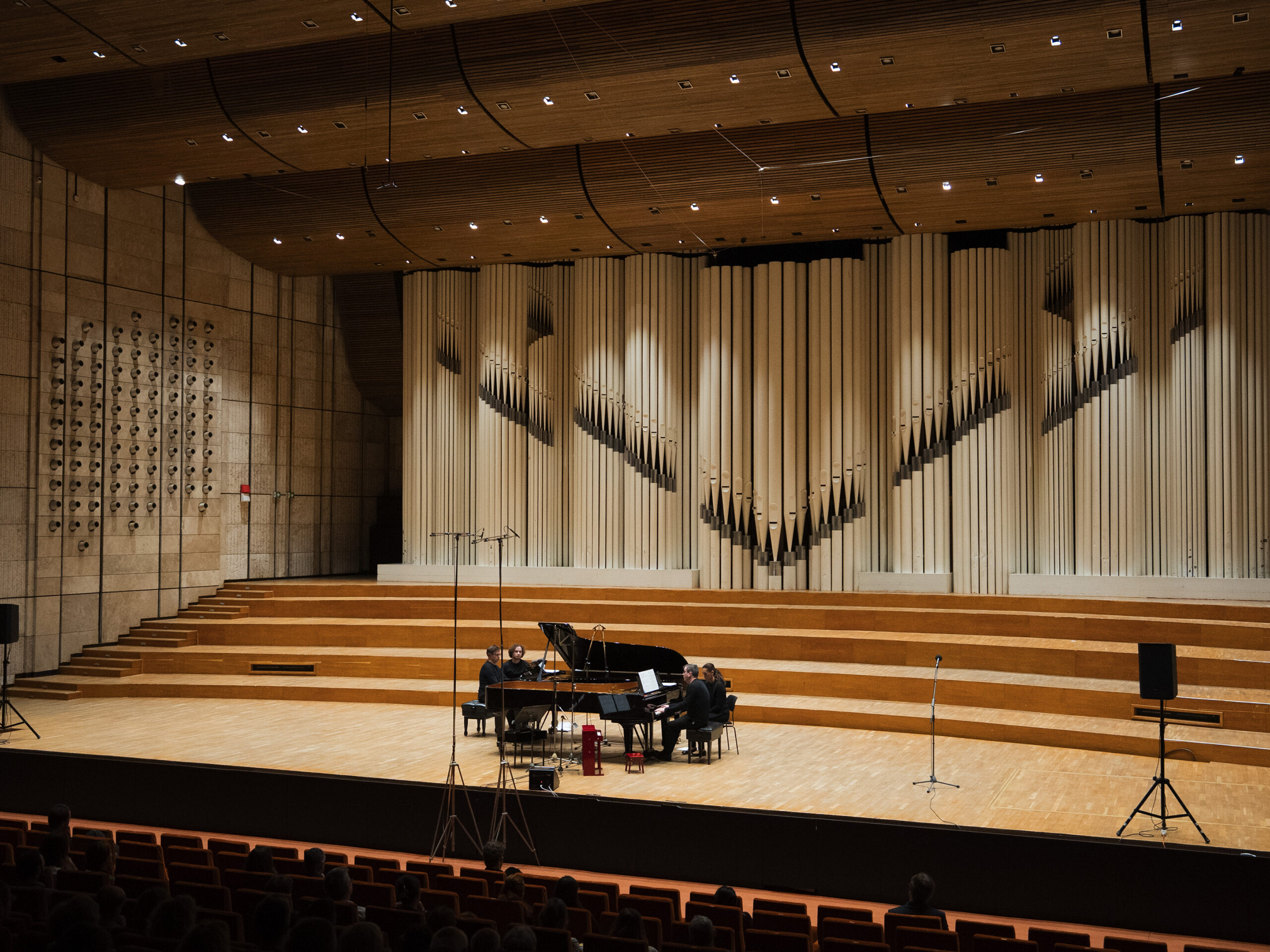
29th September 2025 – BRATISLAVA, Slovak Philharmony Column Hall
Monday evening at the Slovak Philharmonic was dedicated to the Quasars Ensemble. The group first appeared in 2008 and is soon to celebrate its 20th anniversary on concert stages. Under the leadership of the versatile musician Ivan Buffa, the ensemble performs a repertoire primarily composed of contemporary classical music but does not shy away from works of earlier periods. “The phenomenon of Quasars Ensemble simultaneously inspires reflection on the conventionality and indifference of our programming, which these creative collective breaks through,” wrote Ľubomír Chalupka twelve years ago, and this remains true today. The concert program was characterized by works of postwar avant-gardists who, influenced by time and turbulent social events, returned to neoclassicism, neofolklorism, and minimalism.
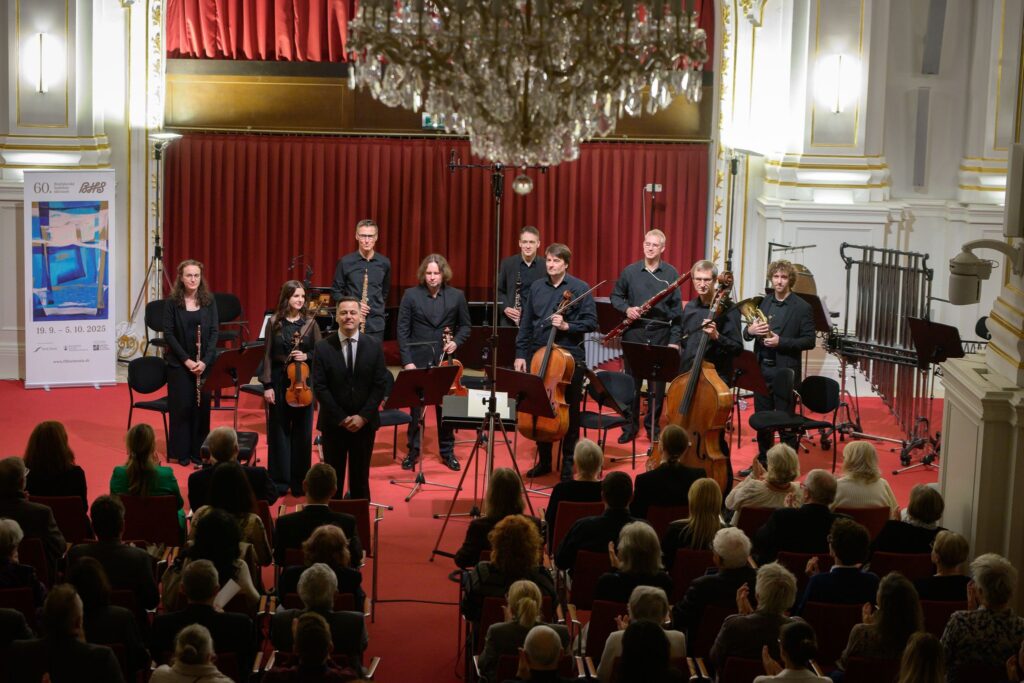
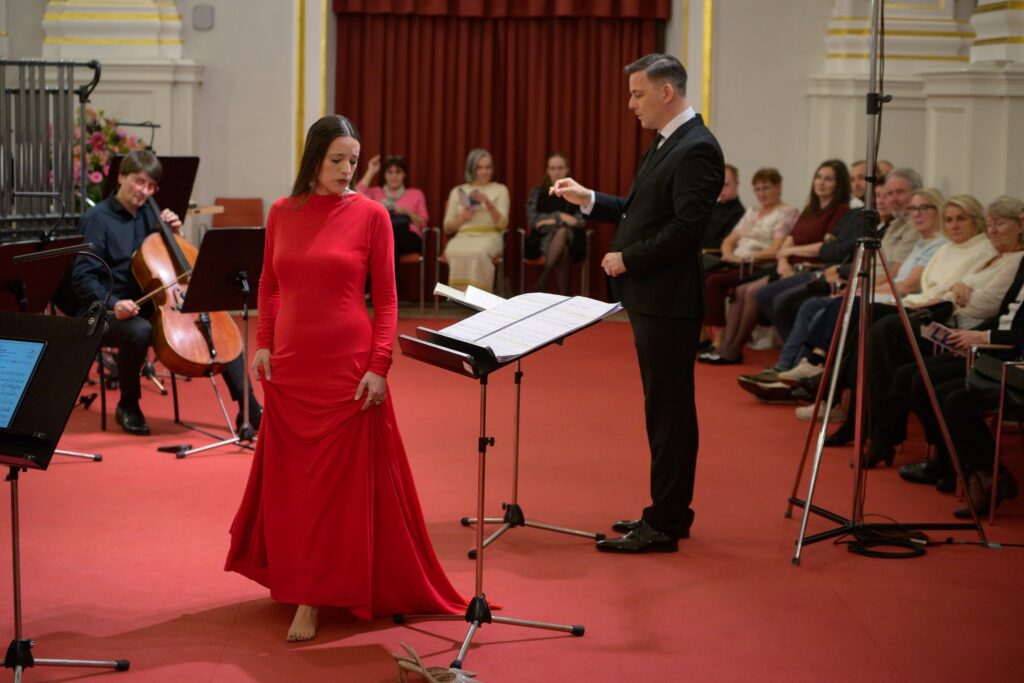
The opening work was Witold Lutosławski’s Dance Preludes. The piece exists in three versions for different instrumentations. The version for clarinet and piano is particularly popular due to its clarity and transparent texture. However, Ivan Buffa skillfully and appropriately chose the version for nonet, since the chamber duo of clarinet and piano might have sounded too sparse in the Column Hall. Even in the larger ensemble setting, the piece retained the clarity of its musical material while enriching the space with colour. In his Folk Songs, Luciano Berio placed vocal models from various countries into a new rhythmic-harmonic structure and allowed the instrumental parts to emphasize and comment on their expressive and cultural origins. His own words clearly frame this intention: “I have a utopian dream, although I know it cannot be realized: I would like to create a unity between folk music and our music – a real, perceptible, understandable connection between old, popular music that is so close to everyday work and music.” This “bridge” principle was manifest very concretely during the concert. Soprano Josefine Göhmann, in the first song Black Is the Colour, adapted her vocal technique to the room’s acoustics, bringing to the fore Berio’s preferred declamatory clarity over a “bel canto” shine. In the Armenian Loosin yelav as well as in the Azerbaijan Love Song, her articulation was notable; the flute with a subtle oriental timbre and harp created a meditative foundation that was not mere ornamentation but a carrier of meaning. The weaker aspect of the performance was the soloist’s vocal range and timbre—the songs’ melodic lines tend toward a darker mezzo-soprano or alto tone. A narrower dynamic singing range sometimes acoustically limited the ensemble.
After the intermission came Martin Burlas’s Strach [in translation Fear, EN]. There was no ostentation, only absolute focus (both on stage and in the audience). The minimalist language was not posturing but a method here—repetition and layering of small motifs forming a vibrating foundation on which tension of almost physical intensity was born. In the Quasars Ensemble’s interpretation, the piece sounded like a work of collective listening; the musicians literally breathed together and sensitively responded to changes in phrases, dynamics, and colour. Perhaps the most powerful moment in the composition was the dialogue between piano and viola—not as a flashy duet but rather a persistent, troubled conversation. Following the purely minimalist piece came a completely different austerity logic—minimal material but maximum tension derived from constant variation. Pierre Boulez’s Dérive I was developed from a single chord but maintained a continuous musical flow with microscopically changing details. The vibraphone lent a delicate, shimmering veil to the work; together with winds, strings, and piano, the interpretation sounded colourful, sometimes mysterious, yet strictly organized. This was precisely the type of Boulezian “economy of means,” where minimal material generates maximum formal tension. To conclude the concert, Quasars Ensemble programmed Bohuslav Martinů’s Rondá, H. 200. This return to energy, danceability, and neofolklorism from the concert’s beginning was shaped by the rondo principle combining spontaneity and bucolic lyricism. The presence of Moravian folk melodies added a rustic Central European charm to the overall impression, which enlivened even the conductor.
The members of Quasars Ensemble once again confirmed that “contemporary classical music” does not mean tormenting the eardrums, but rather a living craft and engagement with meaning. However, for such concerts to become standard rather than a rarity, applause alone is not enough; institutional interest, less aimless PR, and more genuine support where cultural decisions are made are essential.
Hana CHLEBÁKOVÁ