7 November 2026 – BRATISLAVA, A4 – Space for Contemporary Culture
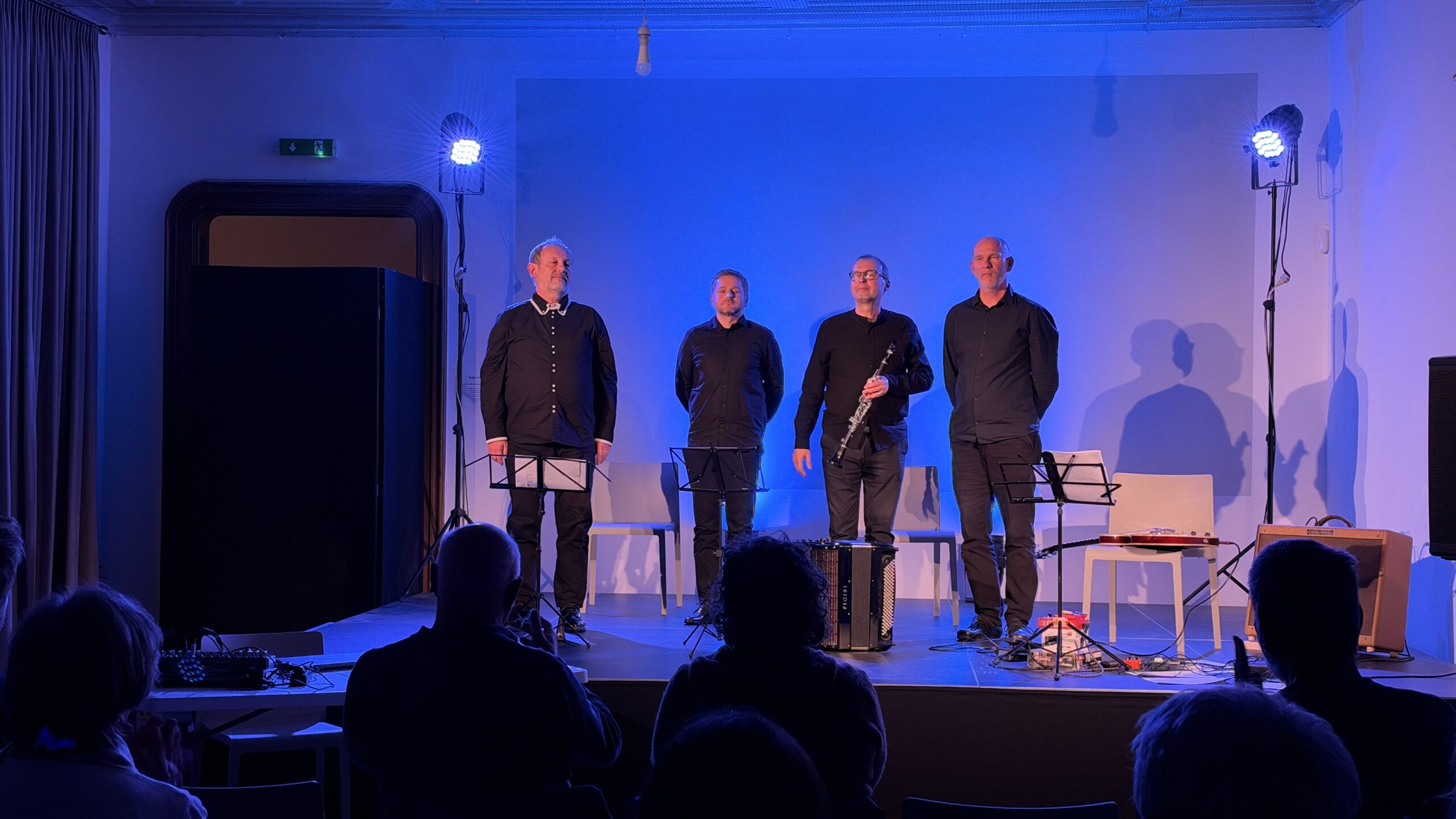
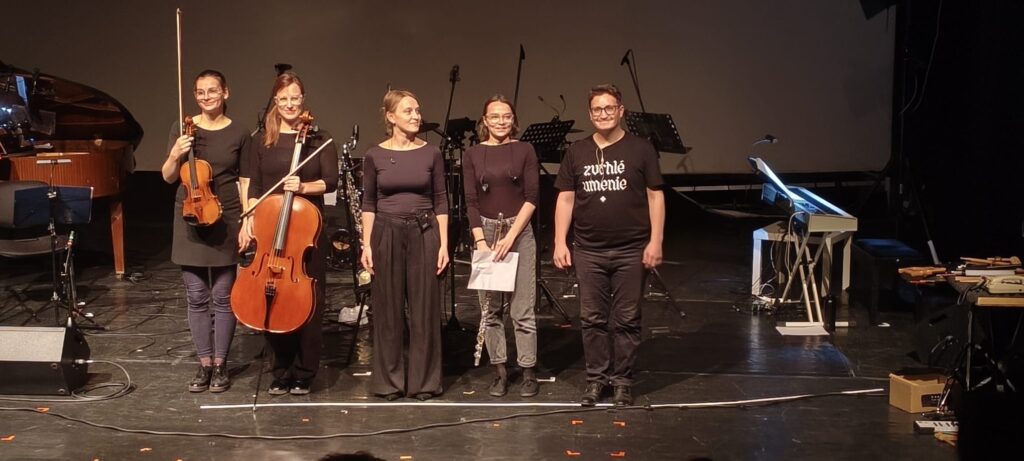
For Bratislava audiences with an interest in contemporary music, the Melos-Étos Festival is a major event. It consistently presents a selection of outstanding works by Slovak and international composers, performed by accomplished musicians. This year’s edition proved exceptionally challenging for the organisers for several reasons. At one point, it seemed that the festival might not take place at all, but thanks to the determination and efforts of its organising team, it eventually went ahead, albeit in a reduced format. One of the highlights of the programme was the concert entitled Post-Digital: Music After the Loss of Technological Innocence, prepared by artistic director Matej Sloboda and his ensemble, EnsembleSpectrum.
The concept of the evening went beyond simply presenting original compositions employing digital technologies and electroacoustic techniques. It raised a broader question about their place in contemporary music, at a time when they are no longer unexplored technological novelties but established means of artistic expression. The individual works offered a variety of perspectives on the possibilities of this medium, ranging from experiments with the origin and production of sound to intense audiovisual experiences.
In this respect, Michael Beil’s exit to enter was an ideal opening work. Combining prerecorded sounds, live performers and live video, the piece prompted listeners to question what they were actually hearing, where the sounds originated and how they were produced. The audiovisual image is in constant flux: musicians taking turns in front of a white screen, projected video footage and the listener’s imagination of what is happening behind the screen combine to create a distinctive effect. From an interpretative perspective, the synchronisation and responsiveness of the performers were particularly impressive. Their precision allowed the audience to follow the events on stage without distraction and become immersed in the interplay between sound, image and its source.
Barbora Tomášková’s Static friction placed somewhat greater demands on the performers’ conventional instrumental skills. In this work, the composer explores the tension between movement and stillness, force and resistance, intention and outcome. This principle is also present in her other works, and Tomášková consistently succeeds in translating it into a compelling listening experience. Static friction evokes the image of an expressive painting from which one cannot tear one’s eyes away. At the same time, it creates an intriguing duality between almost unbearable anxiety and a mildly reassuring sense of solidarity – the awareness that others experience a similar existential unease.
The main themes of Heiner Goebbels’s Bagatellen are communication, confrontation and identity. The dialogue between acoustic instruments and sampler can be understood as an encounter between the analogue and the digital, the old and the new, or perhaps between two individuals who find it increasingly difficult to connect in the modern world. The musical material recalls the composer’s earlier works, but here it is presented in a new context. The original concept gives each instrument the opportunity to stand out, while also testing the performers’ ability to listen to one another, adapt and respond. All the performers met these demands with great conviction.
Liisa Hirsch’s Glides brought a change of pace. Compared with the other works in the programme, this slowly unfolding composition felt remarkably static. It is a study in resonance and in the production of sounds on strings using unconventional means. The sounds produced on the piano strings, around which the other musicians gathered, emerged through the gradual movement of a cassette case. The composer compares this gesture to the movement of a paintbrush across a canvas. As in painting, patience and close attention to gradual transformations are essential here. Despite its intelligently constructed harmonic structure and intriguing concept, however, the composition felt somewhat monotonous and at times became a test of the listener’s concentration.
Alexander Schubert’s audiovisual work Star Me Kitten, by contrast, is an explosion of energy. Rather than offering an intellectual study of the role of digital technology in music, it presents a direct, at times almost lecture-like exploration of the relationship between sound and internet content, incorporating numerous references to popular culture and advertising. It relies on surprise and extreme stimuli, while its underlying structure reveals patterns and influences from other composers, most notably the work of Fausto Romitelli. In its audiovisual character, the piece forms a dramaturgical arc with the concert’s opening work. While Beil explored the mystery of sound’s origins and the relationship between image and source, Schubert ventures into more explicit territory, testing the limits of a more conservative listener’s tolerance. Despite initial technical difficulties, the work lost none of its impact and was rewarded with enthusiastic applause.
The concert demonstrated that digital technologies in contemporary music do not represent a single compositional approach, nor are they merely a source of superficial effects. In the works presented, they became a means of exploring sound, communication, visual perception and the boundaries of the listening experience. It was precisely the diversity of these approaches that gave the evening its coherence and demonstrated the wide range of artistic possibilities offered by the post-digital perspective. Under the direction of Matej Sloboda, EnsembleSpectrum successfully took on the demanding task of presenting works in which technical coordination is inseparable from musical expression.
Jakub GOČ