10th October 2026 – SENEC, Synagogue
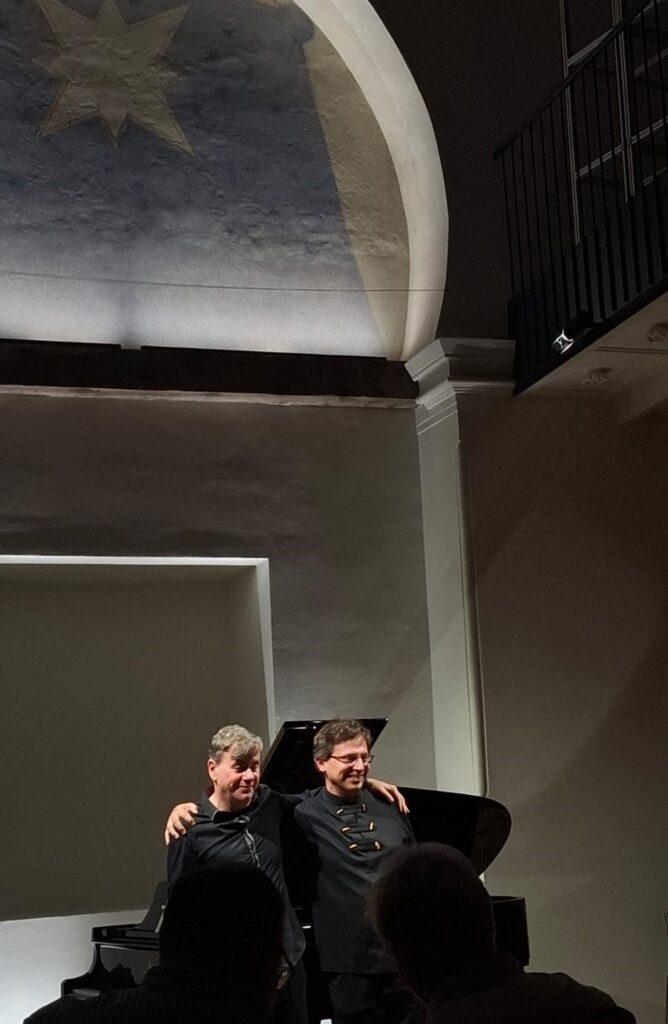
“My pear-shaped pieces cannot be criticised. If they are pear-shaped, they cannot be shapeless.” Satie’s defence of his own work sounds like a joke, yet it is a precise definition of form. It is on exactly this idea that the project brought to the Senec synagogue by pianists Ivan Šiller and Tomáš Boroš is built. The idea of composing music based on Erik Satie’s Three Pieces in the Shape of a Pear originated in Bratislava as early as 1995 at the Evenings of New Music festival. Thirty years later it was revived by a festival in Brno, and further works have been added to it since. After a spring series of concerts, the performers returned to the project, and in their hands the music once again sounded alive, pulsating and breathing.
According to Ivan Šiller, the evening was not meant as a sequence of eighteen pieces but as one large composition in which the works flow into one another and in which the listener is free to get lost. Some might find such a concept chaotic, since it is impossible to identify the composer of any given piece. The audience’s reaction, however, made it clear that “getting lost” did not trouble them in the least.
From the original wave came the works that stood at the birth of the idea. James Tenney’s Three Pages in the Shape of a Pear required the listener to search for Satie, whom the composer concealed beneath a more abstract language. Marek Piaček’s Shaky Pears Remix, by contrast, was energetic and rhapsodic. Next came Peter Zagar’s Une poire supplémentaire, serious and thorough, while Daniel Matej in I tried them and they were all rotten combines playfulness with concentration and a pinch of sarcasm.
The newer pieces took the game further. Hauke Harder works in Birnen, Bohnen und Speck with the interval of a half-octave, and Miroslav Pudlák builds Erixations on a pun combining Satie’s name with his piece Vexations; the result is an elegant and genuinely pleasant composition. Tomáš Boroš presented his own Morceaux – formes – poires as a performer, inventive and tasteful, while Robert Kolář in The New House (for Erik) plays with technical finesse on Satie’s writing style. The programmatic La maison des quatre cheminées I by Vít Zouhar and the rhythmic Souris mécanique by Maarten Nellestijn were among the more dramaturgically typical pieces. Piet-Jan van Rossum’s Messe très courte refers to Satie’s mass in a formally condensed version, leading on to Petr Cígler’s minimalist Horizontal Pleasure. František Chaloupka’s La chaconne aléatoire stood out for its compositional austerity combined with tonal richness, and the evening closed with the autumnal gloom of Martin Burlas’s Freezing and Michal Nejtek’s Pralentir. Petr Hora’s Název zatím nemá received its world premiere, contributing yet another perspective to the project’s concept.
The most memorable piece was David Dramm’s Seconda Prima, in which Ivan Šiller played an invisible piano with his back turned to his partner. Synchronisation was ensured by an audible metronome, a surprisingly simple solution that is at the same time entirely in Satie’s spirit: a straight face with humour just beneath the surface.
The venue played a large part in the overall impression. Following its renovation two years ago, the synagogue is also exceptionally successful acoustically. Every detail of the piano resonated in the space, even the quietest note had its place, and yet the mighty forte never sounded forced.
Eighteen pieces revolving around a single motif could easily have turned into a mere parade of ideas. That this did not happen is to the credit of both the programming and the performers. Satie was right: the shape of a pear is still a shape, and even after thirty years a surprising amount fits inside it.
HANA CHLEBÁKOVÁ