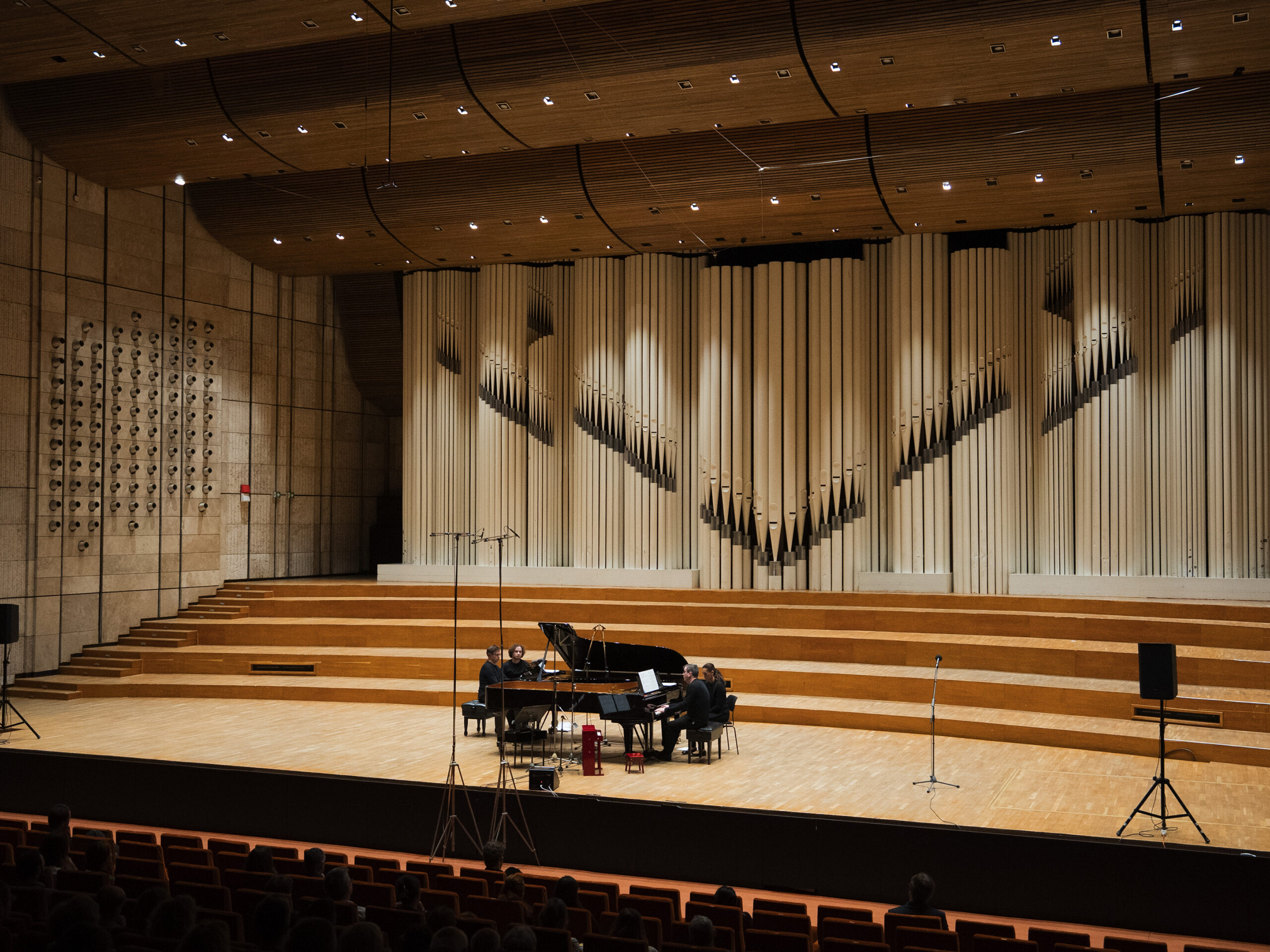
24th September 2025 – BRATISLAVA, Slovak Philharmonic Concert Hall
The 60th anniversary edition of the Bratislava Music Festival promised the audience a presentation of unique artistic ensembles, conductors, and soloists. The ambition of the second concert, dedicated exclusively to works by local composers, was to present pieces by older jubilant composers alongside two premieres that brought a current artistic impulse. However, the challenge of this ambitious programming was the heaviness and inaccessibility of some works, which might have made them less appealing to a broader audience.
The Slovak Chamber Orchestra, under the artistic direction of Ewald Danel, opened the evening with a lively and dance-like Scherzo for string orchestra by Alexander Albrecht. The piece quickly engaged the audience with its soaring, songful melodies and overall neoclassical character. Despite some compositional monotony, contrasts and fullness of sound stood out in the performance. The strong collaboration and communication among orchestra members contributed to a cohesive and convincing musical experience. In Songs from Zaolzie, Roman Berger combines modern treatment of Goral folk motifs with lyrical reminiscences of his childhood. Familiar folk themes likely made the piece attractive to listeners. The orchestra’s performance reflected sensitivity and respect for the composer. This demanding work was interpreted with high quality, although its compositional features—such as frequent voice permutations and a lack of fluidity—clearly contributed to its complexity for the audience.

Ján Valach’s B-A-C-H – Pictures from a Human Life offered an original musical perspective on human existence, using a four-tone motif based on J. S. Bach’s name developed into a universal pattern from birth to farewell. The composer, with a richly and progressively developed compositional style, infused the work with abundant musical imagination and expressive detail. An example is the use of cello and double bass in selected parts as rhythmic accompaniment rather than just traditional melodic instruments. Despite, the chamber orchestra’s interpretation sometimes appeared dull, which was reflected in the relatively weak applause. The brightened lyricism, bucolic meditation, and balladic-rhapsodic darkness were mirrored in Concertino for flute, op. 27, by Andrej Očenáš, as noted by Ondrej Veselý in the program booklet. The excellent cooperation between the chamber orchestra and flutist Monika Štreitová was evident. Štreitová’s performance was clear, convincing, and technically precise, especially in the first part, Rubato e licenza. The rhythmically playful and dance-like Allegro vivo initially sounded less vivid, but the orchestra gradually achieved the desired contrast. The third part, Andante epicamente, featured a lovely, intimate dialogue between flute and viola, culminating in an exceptionally energetic and fierce finale (Allegro vivo. Largo).

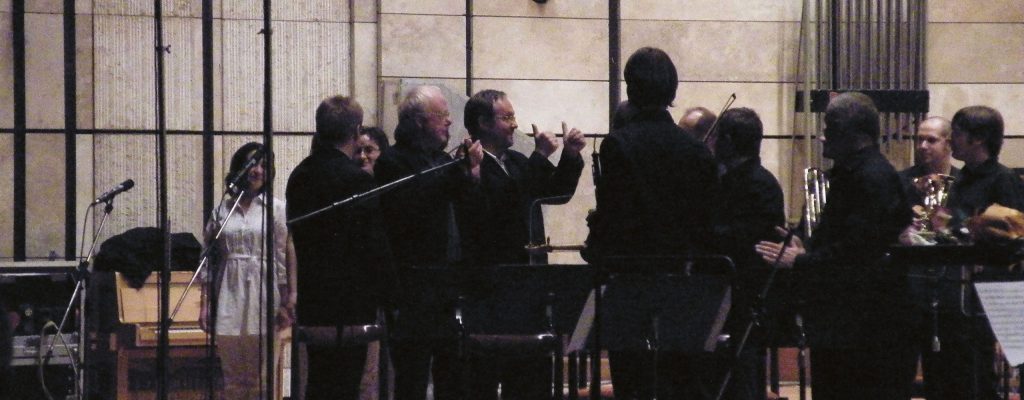
The second half of the concert was dedicated to two world premieres. Lauda Sion, a cantata for soprano and chamber orchestra by Ľuboš Bernáth, belongs to the Middle Generation of Slovak composers. Thomas Aquinas’s text was initially acoustically insufficient, as soprano Marianna Prievozníková Geleneky’s voice occasionally faded and lost clarity. The deficit was compensated in other sections where the soprano part was precisely interwoven with the orchestra’s melody. The concluding Amen closed the work in a nearly heavenly manner. Dramatic and expressively tense instrumental intermezzos provided a welcome contrast. Bernáth again sensitively merged tradition with contemporary musical language, updating the sacred message for today’s audience. In Víťazoslav Kubička’s Requiem for soloists, choir, and orchestra, op. 374, the sensitivity and intimacy of words written by the composer’s wife was reflected. For Kubička, the human voice is the most perfect instrument connecting the message of faith with deep personal expression. Clear delivery was ensured by Marianna Prievozníková Geleneky (soprano), Roman Krško (baritone), and the Lúčnica Choir under longtime choirmaster Elena Matušová. The soloists’ singing appeared light and natural. Requiem, following the tradition of sacred music, was accessible to all listeners precisely because of its clarity of expression and emotional sincerity. However, the conductor Adrian Kokoš’s insufficient work with the choir left some artistic potential unrealized.
Although some pieces, due to their complexity and perceptual demands, appeared cumbersome or dull to the average listener, the concert offered a rich musical experience full of new impulses. The performed works strongly highlighted the continuity and relevance of Slovak musical creativity. Any interpretive shortcomings provide room for further artistic refinement in future events.
Hana CHLEBÁKOVÁ