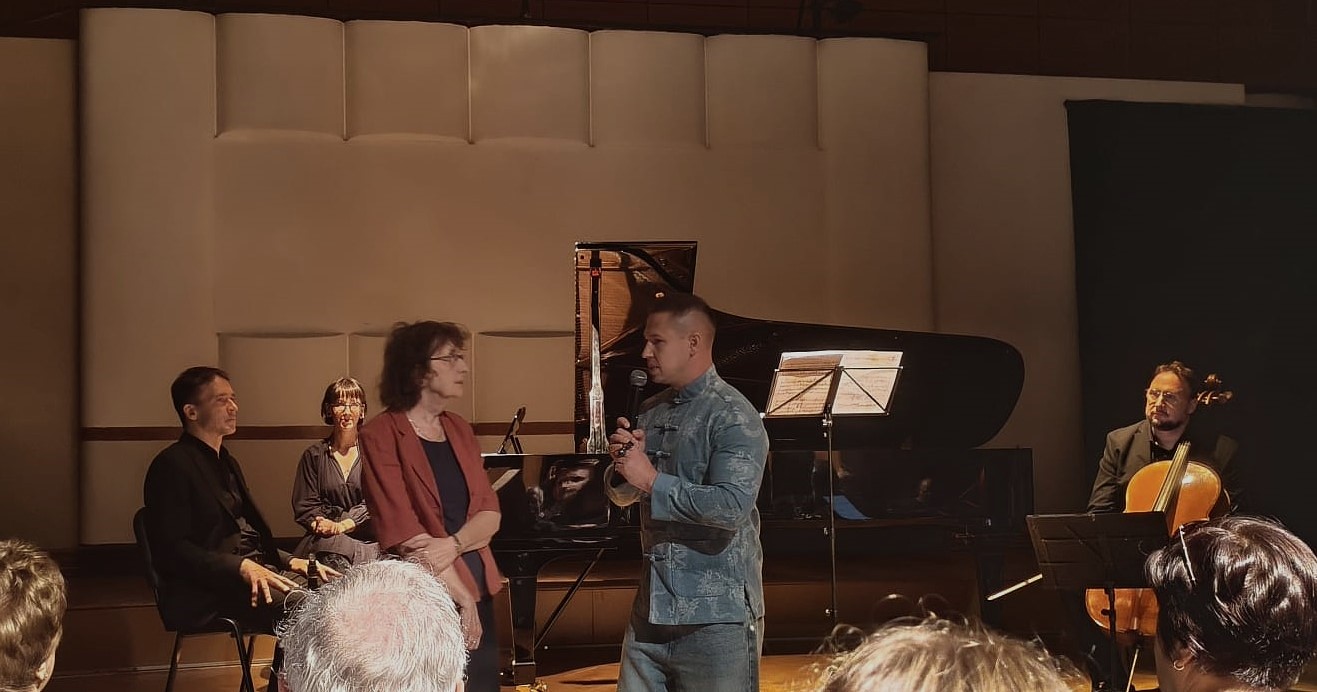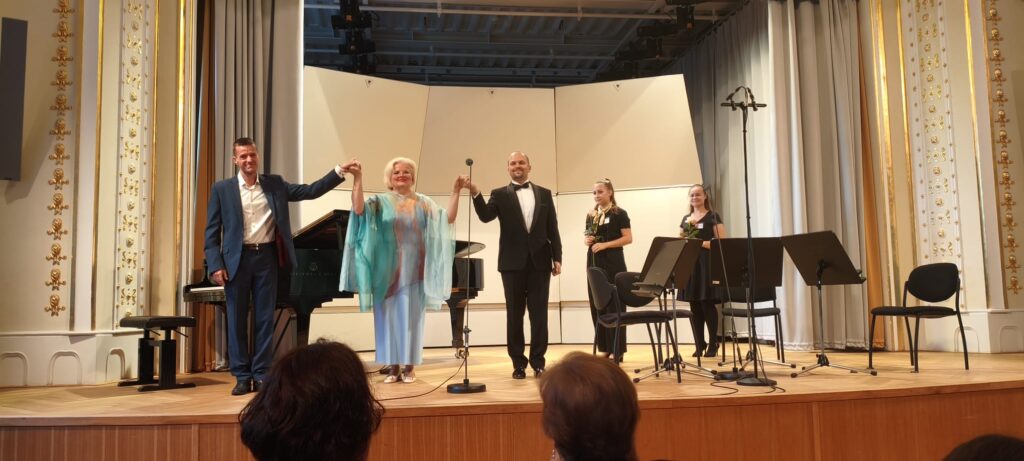
26 September 2026 – BRATISLAVA, Small Hall of the Slovak Philharmonic
The Bratislava Music Festival is one that generally offers a rather conservative repertoire of concerts and works. One of the few exceptions in this year’s programme was a concert double portrait of two celebrating composers and important figures in Slovak music – Oľga Kroupová and Iris Szeghy. Both composers write complex works, often based on philosophical reflections or inspired by other forms of art. Both also draw on the musical traditions of previous centuries, albeit in their own distinctive ways.
Kroupová’s compositions are often based on an apparently simple concept which the composer subsequently develops into a complex structure, drawing on an aesthetic inspired above all by the language of the 20th century. The opening work of the afternoon, Quintessenz for solo violin, was built around the interval of a fifth played on the violin’s open lower strings. Everything grows out of it and everything returns to it. The piece is written without bar lines and gradually develops from a patiently constructed opening into an exceptionally expressive virtuoso finale. For the performer, apart from the obvious technical demands, the greatest challenge is to avoid a flat delivery during the process of construction and, so to speak, maintain the work’s inner tension. In this respect, the choice of violinist Milan Paľa proved to be a very good one. Paľa is an established performer who always brings his own perspective to his interpretation of a work, which in this case was a significant benefit.
After the turbulent finale of the solo composition came a moment of calm in the form of songs based on poems by Saint John of the Cross, La noche oscura. The harmony and melody of this newly premiered work capture cathartic tremors of the soul. They are similarly intricate, complex and changeable as the mystic’s poetry. The greatest strengths of tenor Pavol Oravec and pianist Ondrej Olos were their excellent control and agility. The evocative piano part contained several demanding passages that would have been technically challenging even on their own. It was precisely here that Ondrej Olos’s experience came to the fore: he provided the tenor with solid support, allowing the melodic line to emerge more clearly.
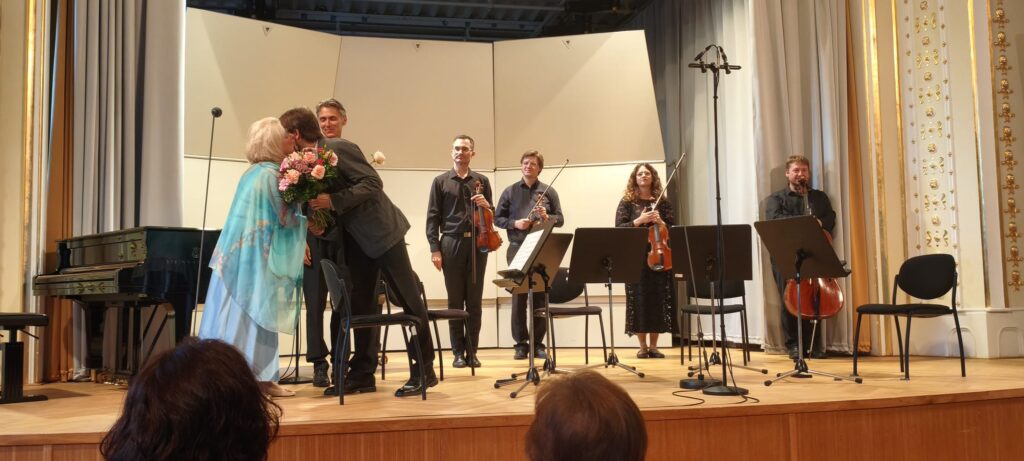
The final work by Oľga Kroupová on the programme was Comments on Plath poems for oboe and string quartet, receiving its Slovak premiere in a performance by oboist Robert Holota and the Mucha Quartet. The main task in performing Kroupová’s works is to understand them and subsequently communicate them clearly to the listener. In this case, that meant conveying a feeling of constant confrontation, incomprehension and rejection, but, as the composer herself put it, also flashes of hope. The piece is highly sectional and explores the upper registers, including frequent harmonics. The timbre of the oboe, which often assumes the function of a voice, worked in a complementary and engaging way in combination with the strings.
After the interval, the concert continued with Psalm for Solo Voice on a Poem by Paul Celan. Szeghy chose an unconventional approach to setting a text expressing sorrow and nihilism. The piece begins with a gentle vocalisation of several notes, dominated, however, by broken, unintelligible murmuring. The complete and comprehensible text appears only at the end. The composer chose an intelligent approach to the text, in which an initially intuited sense of heaviness gradually transforms into a powerful statement. The principal interpretative challenge lies in the gradual building of the atmosphere. As with Milan Paľa, the choice of Eva Šušková can likewise be considered an excellent one. The singer’s controlled and intimate delivery adds considerable value to the work.
Next came Perpetuum mobile for piano. The composer originally conceived this portrayal of the technological myth for prepared piano, with additional physically demanding instructions for the performer. In the revised version for standard piano, she had to settle for a much more conventional sound, yet the piece remained technically extremely demanding. For the listener, this interlude between two sombre vocal works offered a welcome moment of relief; for the performer, in this case pianist Júlia Stahl Novosedlíková, it represented a demand for absolute mental and physical concentration.
In the three songs Prosté a ťažké for voice and piano, based on a poem by Milan Rúfus, Šušková and Stahl Novosedlíková joined forces. The composition, dating from the composer’s student years, shows no signs of immaturity or lack of expressive intensity. The music, with its clarity of style and expression, accompanies a statement about the difficult lives of ordinary people. Rúfus’s poems and the musical texture are both emotionally charged and complex. The danger in performing the piece lies in excessive pathos, making a certain degree of pragmatism and restraint essential; both singer and pianist understood this requirement completely.
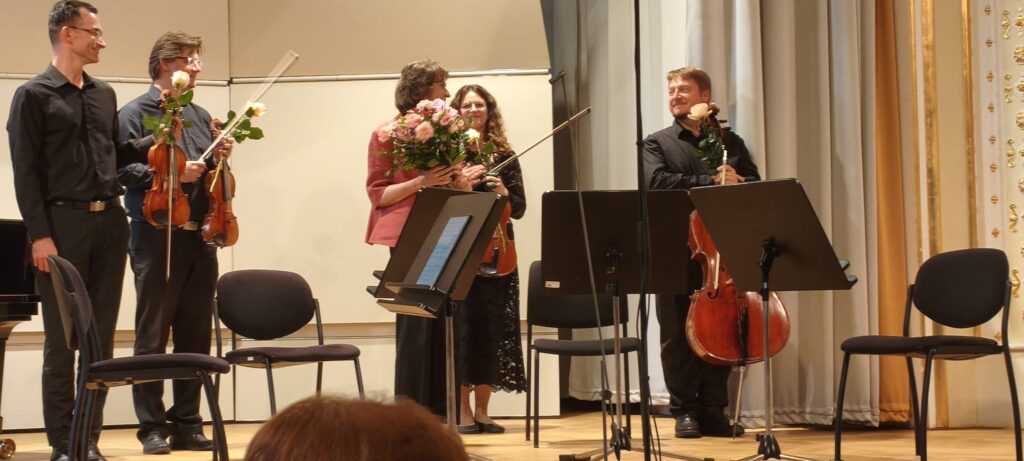
Szeghy quite frequently incorporates elements of early music into her compositions, as well as drawing on both musical and extra-musical sources of inspiration. Yet these fragments never come to dominate the character of the work. Instead, they form a kaleidoscope of the composer’s personality. The same was true of the concert’s final work, String Quartet No. 2 Goldberg. Its title clearly refers to Johann Sebastian Bach’s famous set of variations, yet within the work’s complex structure the musical inspiration is skilfully concealed. What deserves particular praise in the Mucha Quartet’s interpretation is the meticulousness with which they approach the musical material. In Szeghy’s music, every nuance of colour and every detail of a phrase is crucial to forming a complete picture of the work.
Jakub GOČ